The strongest fantasy last name ideas come from a naming rule, not a random pile of dramatic words. Decide what a surname identifies in the culture, choose a small sound and word pattern, then test the names across families, classes, and scenes.
This guide is for authors, game writers, role-players, and worldbuilders who need a connected set of fantasy surnames. It focuses on the system behind the names: who is allowed to use a family name, whether it comes from a place or an ancestor, how it changes after marriage or exile, and what readers should be able to infer. A surname generator can supply sparks, but a consistent world needs a decision that you can repeat.
A fantasy surname does not have to be long, apostrophe-heavy, or impossible to pronounce. Familiar words can feel old when the setting gives them a history, while an invented word can feel arbitrary when it has no relationship to the culture around it. The useful goal is a name that is distinctive enough to remember and ordinary enough to belong to several people in the same society.
The examples below are fictional. A regional filter or a real language can inspire a sound, but it does not prove ancestry, pronunciation, or historical accuracy. When a story depends on a real naming tradition, verify the exact spelling and context with reliable sources or a qualified reader.
What a fantasy surname needs to do
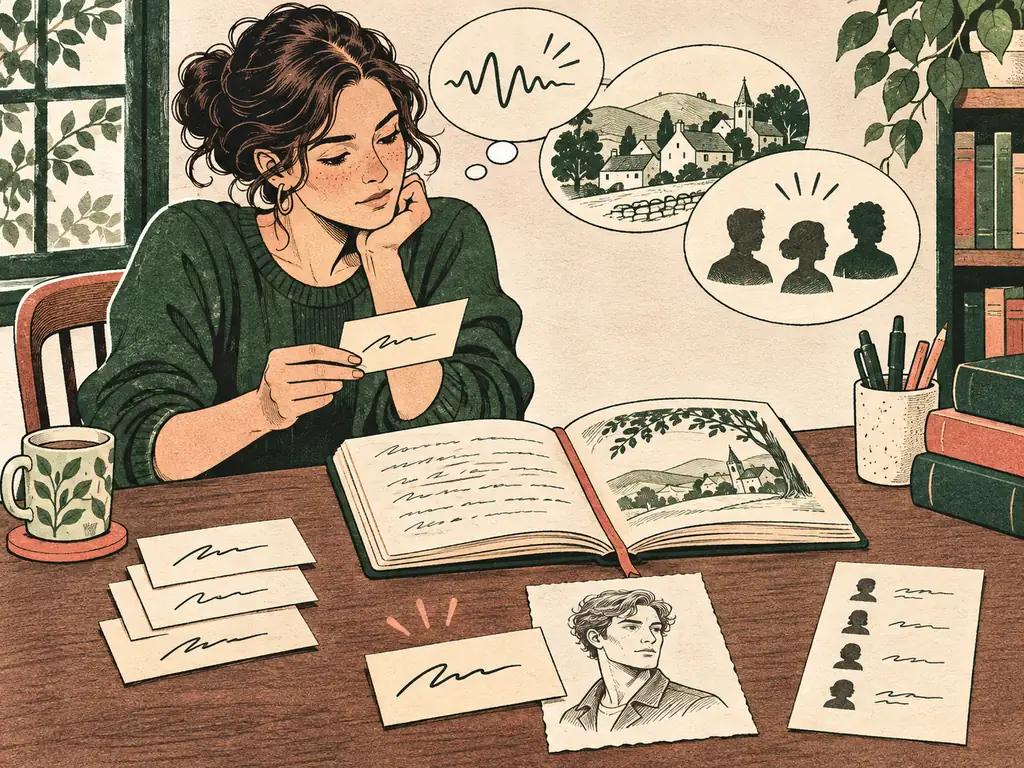
Before writing fantasy last name ideas, decide what information a surname carries. In one kingdom it may identify a household, while in another it may point to a village, a guild, a parent, or a deed. Some people may have no inherited surname at all. A traveling healer could be called Nera of Lowfen, a noble could use a house name, and a city clerk could assign a family name to make two people with the same given name easier to distinguish. Each choice creates different story possibilities.
Write the rule in one sentence: “A surname tells strangers which river settlement a person comes from,” or “A house name is used only by families recognized by the court.” That sentence is more valuable than a list of fifty names because it tells you what a new name must accomplish. If the rule changes for a reason such as migration, adoption, enslavement, marriage, or political reform, record the change on the timeline of the setting.
Keep the reader’s workload in mind. A surname that appears once can be unusual, but a central family name should be easy to recognize in dialogue, a cast list, and a game roster. Give the reader a pattern they can notice without stopping the story to decode it.
- Who receives a surname, and who does not?
- Does the name describe family, place, occupation, title, or reputation?
- Can a person change it, inherit two names, or lose it after exile?
- What should a reader understand immediately, and what should remain a mystery?
Choose the naming rule before the word
A fantasy naming system becomes useful when it operates at more than one scale. Start with the society, then define how a family, clan, guild, or noble house applies the rule. A river culture might use place names such as Reedbank or Upper Vey; a seafaring culture might use a parent’s name followed by a suffix; a magical order might grant an epithet after an apprentice completes a trial. None of these is automatically more authentic than the others. The important question is whether people in the setting understand the same convention.
Give each major culture one or two visible differences rather than a costume of random spelling. You can vary the length of names, preferred consonants, articles such as “of,” or whether a compound is written as one word. Keep a small glossary of roots and endings. If “-mere” means a lake in one language, do not use it for a mountain family unless the story explains the borrowing or the word has changed meaning.
Social use matters as much as etymology. A character may use a house name in court, a village name among neighbors, and a chosen epithet in a rebellion. These forms can all be valid, but the page where each is used should be clear. The best fantasy last name ideas create opportunities for status, loyalty, secrecy, and conflict without forcing every name to deliver a plot twist.
| Surname source | World rule | Fictional example | Review question |
|---|---|---|---|
| Place | The family keeps the settlement or landscape where it began. | Mira Reedbank | Does the place still matter to the family? |
| Ancestor | A parent or founder’s name becomes the inherited form. | Tarin Ilyes | How is the ancestor remembered? |
| Occupation | A trade becomes a surname after the guild standardizes it. | Oren Bellmaker | Would the culture use this trade as an identity? |
| Deed or title | A public act grants a name that descendants may keep. | Sella Dawnward | Who has the authority to grant it? |
Build a repeatable sound and word pattern
Once the social rule is clear, make a small sound inventory. Choose a few consonants, vowel combinations, syllable shapes, and endings that can recur without making every name identical. For a marsh culture, you might favor open vowels and soft endings; for a mountain clan, you might allow clusters such as br, gr, or rk. This is a design constraint, not a claim about how a real language works. It simply helps the reader hear that names belong together.
Compound surnames are a practical starting point because their parts can carry setting information. Pair a landscape, material, animal, weather word, or plant with an object or quality: Ashmere, Frostbridge, Wolfward, or Silverhollow. Then decide when the compound is literal, historical, ironic, or partly worn down by pronunciation. If every character receives a perfect two-word heroic label, the pattern will look like a naming exercise rather than a living culture. Mix short inherited forms with longer ceremonial ones.
For invented roots, write a mini rule before you improvise. You might allow only two syllables, place the family ending on the last stressed vowel, or change a consonant when two roots meet. Say each name aloud and write it in a sentence. Readers do not need a grammar lecture, but they do notice when a supposedly shared language changes spelling from page to page.
- List ten useful roots. Choose roots tied to the culture’s landscape, work, values, or history. Mark which are common words and which are reserved for titles or sacred ideas.
- Pick three structural rules. For example: most family names have two syllables, a clan ending follows a parent root, and compounds are written as one word in everyday speech.
- Combine, then edit. Create more candidates than you need, remove awkward collisions, and keep a few plain names so the setting has social range.
- Test the rule on a second family. A rule that works for one hero may fail for a merchant, an immigrant, or a rival culture. Apply it to people with different status and histories.
Create fantasy last name ideas for different cultures
A useful list of fantasy last names for characters is organized by the world’s needs rather than by a generic “cool” scale. A noble house may favor old place roots and formal particles. A village community may preserve names tied to a craft or a nearby field. An elven or other long-lived group may keep a sound that records an ancestor, while a displaced group may shorten or translate its name to survive in a new city. These are story choices, not universal rules for any real community.
For a noble family, begin with a public origin and a private contradiction. “Ravenmere” might refer to a lake where the first treaty was signed, while the family’s current estate is inland. For a working community, use a name that can be spoken quickly and passed between generations, such as “Cooper,” “Miller,” or an invented equivalent that fits the setting’s technology. For a dark or villainous tone, let the context do some of the work; a plain name attached to a feared institution can be more unsettling than “Doomblade.”
When you borrow a real language’s sound, do not mix a few recognizable fragments and call the result authentic. Label the name as inspired or invented, check the meaning of any real root, and avoid using a sacred, ethnic, or historical marker as a costume. If your story has several cultures, give each one a reason for its naming pattern and let individuals vary within it.
| Use case | Pattern to try | Example set | Avoid |
|---|---|---|---|
| Noble house | Place root plus a formal ending or particle. | Vael Arden, House Merrow | Do not make every noble name equally grand. |
| Village family | Local feature, trade, or a shortened ancestor name. | Fenwright, Orra’s kin | Keep the names easy to use in daily speech. |
| Clan or guild | Shared root with a role-specific ending. | Kestrelhand, Kestrelborn | Explain why membership changes the form. |
| Chosen or earned name | A deed, vow, or public title becomes a surname. | Nera Dawnward | Show who recognizes the new name. |
Test a set across scenes and a cast
Do not approve a fantasy surname in isolation. Put the full name in a line of dialogue, a chapter heading, a family tree, and the smallest interface where a player will see it. Read it at a normal pace and again when a speaker is angry or hurried. Look for repeated initials, rhymes, confusing endings, and names that become hard to scan when several characters share a scene.
Review the set together. If every name starts with the same letter or uses the same four syllables, the culture may feel mechanically generated. If every culture uses the same pattern with different decoration, the world will feel flatter than your notes suggest. Keep a spreadsheet or a simple table with the root, culture, social role, pronunciation note, and first appearance. That record protects consistency during revisions and localization.
A final reader test can be simple: show a short cast list to someone who has not seen your naming notes, then ask which names they can recall and which relationships they infer. Treat the response as usability feedback, not a cultural verdict. Revise the names that create confusion, and keep an unusual name when its difficulty is serving a clear story purpose.
- Can a reader distinguish the important names after a scene break?
- Does each culture have a pattern without making every person sound identical?
- Do spelling, capitalization, hyphens, and diacritics stay consistent?
- Does the name remain usable in search, menus, subtitles, and character lists?
- Have you recorded whether a name is inherited, translated, chosen, or earned?
Research meaning, attribution, and practical limits
Search a real surname or language root before publishing it as part of a fictional culture. A quick check may reveal that a word has a different meaning, a sensitive history, or a pronunciation that your draft assumes incorrectly. This is especially important when a story uses a living community, a historical period, or a language that readers may know well. The goal is not to make a fantasy name impossible to question; it is to avoid presenting guesses as facts.
Generated suggestions are not genealogy evidence, legal clearance, trademark checks, or proof that a username is available. A browser tool can help you compare sounds and styles, but it cannot decide whether a name belongs to a real family or whether a publisher can use it. Keep a note of sources for names you adapt, and change a candidate if it depends on a stereotype or an unverified claim.
The most reliable fantasy last name ideas are transparent about their status. Tell readers when a name is invented, inspired by a broad sound, or based on a fictional place. That small label protects the creative choice and gives collaborators a clear way to discuss revisions.
Frequently asked questions
How do I create fantasy last name ideas that feel consistent?
Start with one social rule, a small sound inventory, and a few recurring roots or endings. Apply the rule to more than one family and keep plain names alongside dramatic ones so the culture feels lived in.
What makes a good fantasy surname?
A good fantasy surname is readable, distinct from the important cast, and connected to a believable history in the setting. It can be simple; the world around it supplies much of the meaning.
Should fantasy surnames use two combined words?
Compounds such as a landscape plus an object are a useful starting pattern, but do not use them for every person. Mix inherited, shortened, occupational, and chosen forms when the culture supports those differences.
Can I use a real surname in a fantasy story?
You can, but check its spelling, pronunciation, context, and possible associations. Present an invented or adapted form honestly, and do not imply that a real name proves a character’s ancestry.
How can I make elven or magical last names sound believable?
Give the group a repeatable sound pattern and a reason for it, then test the names aloud. A few consistent rules usually feel more convincing than many unusual marks or apostrophes.
Is a fantasy surname generator enough for worldbuilding?
It is a useful idea source, not a complete naming system. Use generated candidates to explore sounds, then define the culture’s rule, check the full cast, and verify real-world roots before publication.
Further reading
The Art of Worldbuilding: Creating Surnames — A worldbuilding reference on place, occupation, compound, and inherited surname patterns; use it as a craft source, not as a universal rule.
Mythcreants: How Do I Create Surnames for Characters? — A craft discussion of setting, social context, invented words, and cast readability.