The short answer is that surname vs last name is usually a comparison of two labels for a family name, but the phrases are not interchangeable in every naming system or on every form.
A surname or family name identifies a person's family naming element. In many English-language settings it appears after the given name, so people also call it a last name. The everyday phrase describes where a word appears; it does not explain every person's name structure.
If you are filling in an official form, use the instructions and identity document named by the organization. If you are writing fiction, treat the terms as useful labels rather than universal rules. This guide shows the common usage, where it can mislead, and how to make a careful choice.
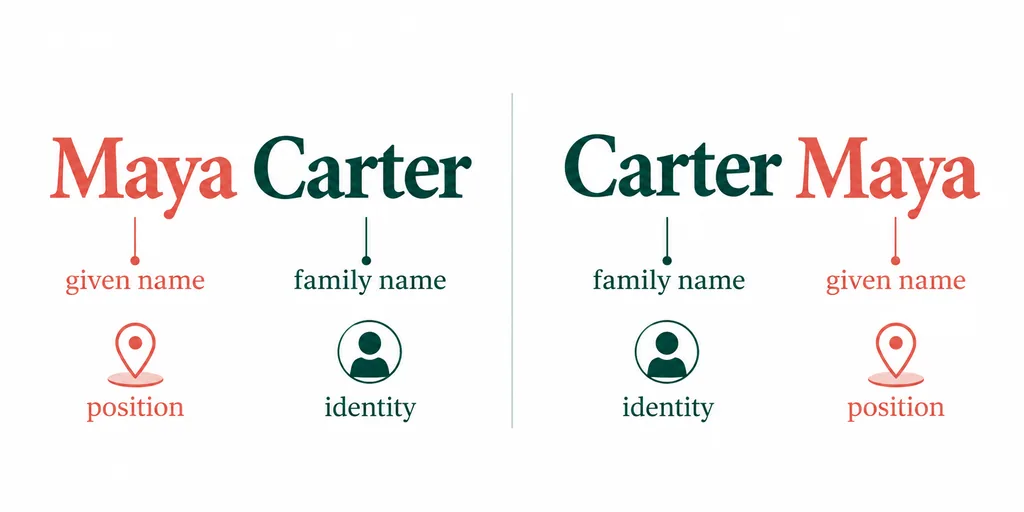
Surname vs last name: the practical difference
Surname is the more general term for a family name in English. Family name is another common label, especially when a form needs to work across different naming conventions. A surname may be inherited or otherwise part of a person's recorded name; the word alone does not tell you how that name was formed.
Last name is an everyday expression based on position: it usually means the name written at the end in the order a speaker expects. In a familiar English example such as Maya Carter, Carter is both the surname and the last name. Because the two ideas often overlap, dictionaries and casual conversation may treat them as synonyms.
The phrase surname vs last name often compresses two questions into one: which name element belongs to the family, and where a form expects that element to appear.
The difference matters when the expected order changes or a form asks for a specific field. A person can have a family name that is written first, several family-name elements, or a record whose order should not be rearranged. Calling a family name a last name can therefore be imprecise outside the convention a form assumes.
| Term | What it usually identifies | Does it describe position? | Common use |
|---|---|---|---|
| Surname | A family-name element in a person's name | No; the order can vary | General discussion, records, and name references |
| Family name | The family-related name field or element | No; it is not defined by being last | Forms and international instructions |
| Last name | Usually the family name in a familiar Western order | Yes; the phrase refers to the final position | Everyday English, especially in the United States |
These are common English-language usages, not a rule for classifying every name. A form may use surname and family name for the same field, while a casual speaker may say last name. Read the surrounding instructions before deciding that the labels are identical in a particular system.
A practical shortcut: surname and family name usually identify the family-name element; last name usually assumes that element comes last. The words describe a common pattern, not a guarantee about an individual.
Why name order matters
People do not use one universal order for given names and family names. In many English-language examples, the given name comes first and the family name follows it. Other languages and official systems may place the family name first, preserve a different local order, or display a romanized name differently for a particular audience.
For example, the same two elements can be presented as Maya Carter or Carter Maya in a simple teaching illustration. The position of Carter changes, but the example does not change which element is being treated as the family name. Real people's names should be handled from their own records and preferences, not inferred from a generic example.
Japan is one documented example where official English-language documents changed their ordering convention. The Japan International Cooperation Center reported that, from January 1, 2020, Japanese citizens' family names would appear before given names on official documents in English. That dated policy example is useful because it shows why the phrase last name cannot safely identify a family-name field by position alone. It is not a complete guide to every Japanese document or every person's preferred presentation.
| Illustrative display | Written order | What to notice |
|---|---|---|
| Maya Carter | Given name, then family name | Carter is last in this display and is the family-name element in the example. |
| Carter Maya | Family name, then given name | Carter remains the family-name element even though it comes first. |
| A recorded multi-part name | Follow the person's or issuing authority's format | Do not assume that the final word alone represents the whole family name. |
Name order can also be affected by romanization, capitalization, punctuation, document layout, and the way a person chooses to present a name in another language. A comma or a field label may signal order, but it is not a substitute for the record's own instructions.
For any real person, preserve the spelling and structure they provide. Avoid turning a cultural example into a rule about everyone from a country or language group.
What to enter when a form asks for a surname or last name
Start with the form's own definition. A field labeled surname or family name often asks for the family-name element; a field labeled last name may assume a particular order. The organization may explain how to enter names that have multiple parts, no spaces, or no single family-name field.
For the surname vs last name question on a form, follow its field definition and the identity record it asks you to match rather than guessing from the word last.
When a form is connected to travel, banking, school, health care, employment, or another official record, accuracy matters more than choosing the English phrase that sounds most natural. Use the identity document and instructions requested by that organization.
- Read all adjacent labels. Look for given name, first name, middle name, surname, family name, and any note about order. The labels together often explain how the form expects the information.
- Follow the named source record. If the organization asks you to match a passport, national ID, or other record, use its spelling and order rather than rebuilding the name from memory.
- Keep every required name element. Do not drop a second surname, prefix, hyphen, space, or diacritic simply because the form uses the singular phrase last name. Follow the form's stated limits.
- Do not guess from the final word. A final token may not be the family name, and a family name may contain more than one element. A system can also display a name differently from how it is written locally.
- Ask the issuer if the fields do not fit. When the form cannot represent the structure in your official record, contact the organization for its approved method. Avoid inventing a split that could create a mismatch later.
A useful example is a form that has separate Given name and Surname boxes. It may be asking for two fields, not asking you to reverse the order shown on a document. Another form may define Last name as the family-name field. The printed help text, issuing organization's instructions, and identity record decide which case applies.
This article explains English wording; it is not legal, immigration, or document-specific advice. Requirements differ by organization and can change. For a real application, use the current instructions from the office that will process it.
Choosing a surname for a fictional character
For a story, game, or role-playing character, a surname is a creative choice rather than a form field. Begin with the setting and the character's relationships. A familiar name can make a contemporary cast feel grounded; a more unusual name may support a speculative world, but it should still be easy for the intended audience to read and remember.
Say the full name aloud and place it in dialogue, a cast list, and a short scene. Notice whether the given name and surname compete for attention, whether several characters sound too similar, and whether the chosen spelling stays consistent across chapters or menus.
When a story borrows from a real language or culture, a generator result is only a starting point. Verify spelling, pronunciation, order, and context with reliable references or a qualified reader. Do not present a style label as proof of ancestry or historical accuracy.
- Does the surname fit the setting and tone without doing all the character work?
- Can a reader pronounce or distinguish it beside the rest of the cast?
- If it draws on a real naming tradition, have you checked the language and context?
- Before public or commercial use, have you checked for character, brand, handle, or trademark conflicts?
Surname vs last name FAQ
Is a surname the same as a last name?
Often, yes. In many English-language settings, the surname is written last, so people use surname and last name for the same family-name element. The terms are not identical in every naming order or form.
Is family name another word for surname?
Usually. Family name commonly identifies the family-name element without saying where it appears in the written order. A form may define the term more specifically, so read its instructions.
Is the surname first or last?
It depends on the language, record, and person's preferred presentation. In a familiar English order it is often last; in other systems the family name may come first. Do not infer a real person's surname from position alone.
What should I enter if a form asks for my last name?
Use the form's instructions and the identity record it asks you to match. If the fields do not fit the name structure on that record, ask the issuing organization how to enter it.
Can a surname have more than one part?
Yes. A family name can contain multiple words or components, and forms do not all handle those structures the same way. Preserve the version shown on the relevant record and follow the form's guidance.
Reference
Japan International Cooperation Center: family-name-first order on official English documents — A dated Japan-specific policy notice checked for this article; it does not define every person's preferred name display.